Showing posts with label Fire. Show all posts

Saturday, May 3, 2014

International Firefighters Day – 2014


By Terry Orr


International Firefighters’ Day is observed each year on 4th May. On this date you are invited to remember the past firefighters who have died while serving our community or dedicated their lives to protecting the safety of us all. At the same time, we can show our support and appreciation to the firefighters worldwide who continue to protect us so well throughout the year. (Source: http://www.firefightersday.org)  


“The role of a firefighter in today’s society – be it urban, rural, natural environment, volunteer, career, industrial, defence force, aviation, motor sport, or other is one of dedication, commitment and sacrifice – no matter what country we reside and work in. In the fire service we fight together against one common enemy – fire – no matter what country we come from, what uniform we wear or what language we speak.” - Lt JJ Edmondson, 1999


Did you know that May 4th is also the feast day of Saint Florian? According to legend, Saint Florian saved an entire burning village in Ancient Rome with a single bucket of water. He is the patron saint of chimney sweeps and firefighters, so it is fitting that we celebrate International Firefighters Day on this particular date. (Source: http://www.punchbowl.com/holidays/international-firefighters-day)


Previous KISBYTO article on this subject can be found here

http://kisbyto.blogspot.com/2011/05/international-firefighters-day.html


Friday, July 5, 2013

Barbeque Safety


By Nurse Diane

Well most of you may have already been cooking out this summer, and many of you probably did some barbequing on Thursday as we celebrated Independence Day...Some of you may be waiting til today to get the grill started, and these tips and reminders are for you.


Grilling during the summer months is an all American past time, and I love this story about grilling:

Barbecue Routine
1) The woman buys the food.
2) The woman makes the salad, prepares the vegetables, and makes dessert.
3) The woman prepares the meat for cooking, places it on a tray along with the necessary cooking utensils and sauces, and takes it to the man who is lounging beside the grill - beer in hand.
Here comes the important part: 4) THE MAN PLACES THE MEAT ON THE GRILL.
5) The woman goes inside to organise the plates and cutlery.
6) The woman comes out to tell the man that the meat is burning. He thanks her and asks if she will bring another beer while he deals with the situation.
Important again:
7) THE MAN TAKES THE MEAT OFF THE GRILL AND HANDS IT TO THE WOMAN.
8) The woman prepares the plates, salad, bread, utensils, napkins, sauces and brings them to the table.
9) After eating, the woman clears the table and does the dishes.
And most important of all:
10) Everyone PRAISES the MAN and THANKS HIM for his cooking efforts.
11) The man asks the woman how she enjoyed 'her night off.' And, upon seeing her annoyed reaction, concludes that there's just no pleasing some women....


There are a few safety rules to make sure your BBQ experience is a pleasant one.
1.  First and most important is the Fire.  Never leave your fire unattended.  Make sure you have a fire extinguisher on hand. A fire can get out of hand before you can blink your eyes, and the wind can blow the fire in the direction of your home or nearby property.
2.  Location, make sure you place your BBQ in the proper place, not close to any objects that can become inflamed.  For answers to any questions you may have on placement, check the operation manual of your equipment.  Instructions can also be found on the company's website if you have misplaced yours.
3.  Fuel.  Do not put gasoline on your coals.  I speak from personal experience on this one. The gas will explode in your face, and if you are still holding the gas can, it can also catch on fire.  It is best, if you are using a charcoal grill to use either lighter fluid, or those self-start coals.  Be sure to read the operation manual if you are using a gas grill.
4.  Food.  Fire is not the only concern, the preparation of the meat is also important.  Make sure the grill is clean before placing prepared meat on it. Be sure not to leave the meat out too long before putting it on the grill.  Bacteria will grow quickly make sure you keep it covered before serving
5.  Grease.  If the meat you are cooking has alot of grease or fat on it, make sure you cook with care, turning the meat may cause fire to flare up, and you want to make sure you aren't in it's path.
6.  Make sure you put the fire out before you leave.  Covering the grill, or turning off the gas will normally get the job done.  When using a charcoal grill, make sure to check back to make sure all the coals are out.

There is nothing better to me than a grilled burger with homegrown tomatoes.  If you want to grill burgers, chicken, ribs or steak, or anything else, please use proper precautions to make your dining experience the best ever.

(Photos from Google) 

Monday, June 24, 2013

Burn Awareness Week


By Nurse Diane

June 1st:
Just moved to Texas!
Now this is a state that knows how to live!!
Beautiful sunny days and warm balmy evenings.
What a place!
It is beautiful.
I've finally found my home.
I love it here.

June 14th:
Really heating up.
Got to 100 degrees today. Not a problem.
Live in an air-conditioned home, drive an air- conditioned car.
What a pleasure to see the sun everyday like this.
I'm turning into a sun worshipper.

June 30th:
Had the backyard landscaped with western plants today.
Lots of cactus and rocks.
What a breeze to maintain.
No more mowing the lawn for me.
Another scorcher today, but I love it here.

July 10th:
The temperature hasn't been below 100 all week.
How do people get used to this kind of heat?
At least it's kind of windy though. But getting used to the heat is taking longer than I expected.

July 15th:
Fell asleep by the community pool.
Got 3rd degree burns over 60% of my body.
Missed 3 days of work.
What a dumb thing to do.
I learned my lesson though.
Got to respect the ol' sun in a climate like this.

July 20th:
I missed my cat, Lomita, sneaking into the car when I left this morning.
By the time I got to the hot car at noon, Lomita had died and swollen up to the size of a shopping bag, then popped like a water balloon.
The car now smells like Kibbles and Shits.
I learned my lesson though.
No more pets in this heat.
Good ol' Mr. Sun strikes again..

July 25th:
The wind sucks.
It feels like a giant freaking blow dryer!!
And it's hot as hell.
The home air-conditioner is on the fritz and the AC repairman charged $200 just to drive by and tell me he needed to order parts.

July 30th:
Been sleeping outside on the patio for 3 nights now.
$225,000 house and I can't even go inside.
Lomita is the lucky one.
Why did I ever come here?

August 1st:
It's 105 degrees.
Finally got the air-conditioner fixed today.
It cost $500 and gets the temperature down to 85.
I hate this stupid state.

August 3rd:
If another wise guy cracks, 'Hot enough for you today?'
I'm going to strangle him...Damn heat.
By the time I get to work, the radiator is boiling over, my clothes are soaking wet, and I smell like baked cat!!

August 5th:
Tried to run some errands after work. Wore shorts,
When I sat on the seats in the car, I thought my butt was on fire.
My skin melted to the seat.
I lost 2 layers of flesh and all the hair on the back of my legs and butt.
Now my car smells like burnt hair, fried butt and baked cat.

Aug 6th:
The weather report might as well be a damn recording.
Hot and sunny...Hot and sunny...Hot and sunny...
And the weatherman says it might really warm up next week.
Doesn't it ever rain in this damn state?
Water rationing has been on the last six weeks.
My $1,700 worth of cactus might just dry up and blow over.
Even the cactus can't live in this damn heat.

August 8th:
Welcome to HELL!
Temperature got to 110 today. Cactus are dead.
Forgot to crack the window and blew the damn windshield out of the car.
The installer came to fix it and guess what he asked me???
"Hot enough for you today?"

August 10th
My sister had to spend $1,500 to bail me out of jail.
Freaking Texas...
What kind of a sick demented idiot would want to live here??
Will write later to let you know how the trial goes...

~ Author Unknown


Summer is a great time to be outside, There are many fun activities that you can't do during the summer months.  The family picnic and BBQ, campfires, celebration fireworks and just laying out under the sun.   These activities can also cause some serious burns, not to mention the regular routine home activities.

While most adults are aware of the temperatures associated with cooking and heaters, young children are not.  They are curious, and want to explore new and different things in their surroundings. It is important to remember that children, especially those ages 4 and under, may not perceive danger, have less control of their environment, may lack the ability to escape a life-threatening burn situation and may not be able to tolerate the physical stress of a burn injury.

According to safekids.org, Please keep a careful watch on small children especially around the BBQ or campfire, make sure they are a safe distance away, and there is no gas nearby.
Every day, 352 children ages 19 and under are injured as a result of a fire or burn-related cause.
Among children under 5 years of age, scalds or contact burns are responsible for 90 percent of burn injuries.
Children have thinner skin than adults, which can result in a more severe, burn.
The most common places children experience scalds are in the kitchen or dining rooms and in the bathrooms.
The maximum recommended residential water temperature is 120˚F (48˚C).


Their site lists some safety tips for you to follow in the kitchen and bathroom.  They include:
KITCHEN AND HOT FOOD

Keep children at least 3 feet from hot appliances, pots, pans or food.
Use spill-resistant mugs when drinking hot liquids around children.
Avoid using tablecloths or anything a child can pull on and cause hot food to spill.
When cooking, use back burners and keep pot handles turned towards the back of the stove.
Always tuck cords from appliances where children cannot reach them.
Never hold a child when cooking something hot.
Test and stir all food before serving children to make sure it is cool enough to eat.
Supervise children closely when they are in or near the kitchen.

BATHROOM

Always test the bath water with your hand before bathing children.
When children are in or near the bath, watch them closely checking the water temperature frequently.
If you are unable to control the temperature that comes out of your faucet, install special tub spouts or shower heads that can shut off the flow of water when it gets too hot.


Sunscreen is also a must have for the summer months!   Make sure you limit your time outside to only a few hours, use plenty of sunscreen, check the SPF level, the higher the better and wear hats or long sleeves if possible.  Stay in the shade as much as you can, and drink plenty of liquids!
This week, and every week, keep these tips in mind to prevent any accidental burns or scalding, and keep yourself and family safe.

Tuesday, October 9, 2012

Fire Prevention Week and Month


(Google Image) 
By Terry Orr

“Fire! Fire! Fire! Class Alpha Fire in compartment 01-….” Hearing this announcement over the ships 1-MC (general announcement system) gets all hands immediate attention.  The other related announcement starts with “this is a drill, this is a drill…Fire….”  This is equally important as practice makes perfect (or nearly) and hones your firefighting skills.  For those who spend the days on land – they seldom if ever practice basic firefighting skills, understand the different types of fires, practice emergency exits, or know to prevent most fires. So set us start by taking a short fire prevention quiz.

(Google Image) 

Fast Facts About Fire
(From National Fire Protection Association)

(Google Image) 
Home Fires
  • One home structure fire was reported every 85 seconds in 2010.
  • Most fatal fires kill one or two people.  In 2010, 19 home fires killed five or more people. These 19 fires resulted in 101 deaths.
  • In 2010, U.S. fire departments responded to 369,500 home structure fires. These fires caused 13,350 civilian injuries, 2,640 civilian deaths, and $6.9 billion in direct damage.

(Google Image) 

Escape Planning 
  • According to an NFPA survey, only one-third of Americans have both developed and practiced a home fire escape plan.
  • Almost three-quarters of Americans do have an escape plan; however, less than half actually practiced it.
  • One-third of Americans households who made and estimate they thought they would have at least 6 minutes before a fire in their home would become life threatening. The time available is often less. And only 8% said their first thought on hearing a smoke alarm would be to get out!

(Google Image) 

Smoke Alarms
  • Almost two-thirds (62%) of reported home fire deaths resulted from fires in homes with no smoke alarms or no working smoke alarms.
  • Working smoke alarms cut the risk of dying in reported home fires in half.
  • In fires considered large enough to activate the smoke alarm, hardwired alarms operated 92% of the time, while battery powered alarms operated only 77%  of the time.

(Google Image) 

Cooking
  • Cooking has been the leading cause of reported home fires and home fire injuries since 1990. Unattended cooking was by far the leading cause of these fires; Two-thirds of home cooking fires began with ignition of cooking materials, including food, cooking oil, fat, or grease.
  • Cooking caused two of every five (42%)  of reported home fires, roughly one of every seven  (15% ) home fire deaths, and two of every five (37% ) home fire injuries, and 11% of direct property damage from home fires in 2010.
  • Ranges accounted for the 58% of home cooking fire incidents. Ovens accounted for 16%.
  • Children under five face a higher risk of non-fire burns associated with cooking than being burned in a cooking fire.
  • 90% of burns associated with cooking equipment resulted from contact with hot equipment or some other non-fire source.

(Google Image) 

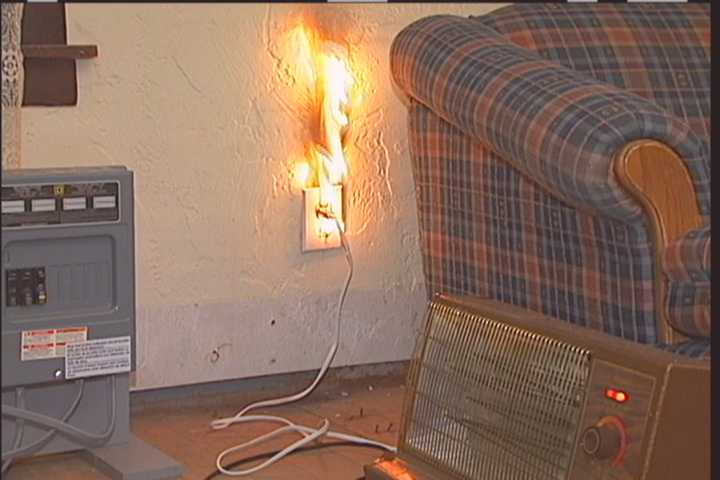
Heating
  • Heating equipment was the leading cause of reported home fires in the 1980s and has generally ranked second since them.  It is the second leading cause of home fire deaths. Fires involving heating equipment peak in December, January and February, as do deaths from these fires.
  • The leading factor contributing to heating equipment fires was failure to clean, principally creosote from solid fueled heating equipment, primarily chimneys.
  • Portable or fixed space heaters, including wood stoves, were involved in one-third (32%) of home heating fires and four out of five (79%) home heating deaths.
  • Half of home heating fire deaths resulted from fires caused by heating equipment too close to things that can burn, such as upholstered furniture, clothing, mattresses or bedding.

(Google Image) 

Smoking Materials
  • In 2010, smoking materials started and estimated 17,500 home structure fires, resulting in 540 deaths, 1,320 injuries and $535 million in direct property damage. Smoking materials are the leading cause of home fire deaths.
  • Sleep was a factor in two of every five home smoking material fire deaths. Possible alcohol impairment was reported in one quarter of these deaths.
  • In recent years, Canada and the United States have required that all cigarettes sold must be “fire safe,” that is have reduced ignition strength and less likely to start fires.

(Google Image) 

Electrical
  • Half (49%) of home electrical fires involved electrical distribution or lighting equipment. Other leading types of equipment were washer or dryer, fan, portable or stationary space heater, air conditioning equipment, water heater and range.
  • In 2010, electrical failures or malfunctions were factors in an estimated 46,500 home structure fires resulting in 420 deaths, 1,520 injuries and $1.5 billion in property damage.

(Google Image) 

Candles
  • On average, there are 35 home candle fires reported per day.
  • More than one-third of these fires started in the bedroom.
  • More than half of all candle fires start when things that can burn are too close to the candle.
  • In 2010, candles caused 3% of home fires, 4% of home fire deaths, 6% of home fire injuries and 5% of direct property damage from home fires.

(Google Image) 

Home Fire Sprinklers
  • Automatic fire sprinkler systems cut the risk of dying in a home fire by about 83%.
  • Home fire sprinklers can contain and may even extinguish a fire in less time than it would take the fire department to arrive on the scene.
  • Sprinklers are highly effective because they react so quickly in a fire. They reduce the risk of death or injury from a fire because they dramatically reduce the heat, flames and smoke produced, allowing people time to evacuate the home.


Be sure to download and print Sparky’s “Home Fire SafetyChecklist” and make sure your home is prepared.

Remember to be fire and safety aware everyday – if you see something that is a potential hazard – fix it then!

References and Links:


Happy Birthday Dad!

  October 15, 2023 Each day, I walk into my den to see what in new and what are my ‘to do’ items for the day and say good morning, Dad. This...