Showing posts with label Quiz. Show all posts

Thursday, October 18, 2012

National Mammography Day


(Google Image) 
By Nurse Diane

October is Breast Cancer awareness month; it is also Metastatic Breast Cancer Awareness Month.  We discussed both earlier this month.  Today is the day to do something about it.  Today is Mammography day.  If you are 40 or over, and have not had a mammogram this year, take a few minutes today and schedule one before the year is over.  Check with your doctor or local hospital, you may even get a free or discounted mammogram.

(Google Image
The third Friday in October each year is National Mammography Day, first proclaimed by President Clinton in 1993. On this day, or throughout the month, women are encouraged to make a mammography appointment.
(Google Image)
Below is a quiz to take to test your knowledge about Breast Cancer and Mammograms.  There are only 8 True and False Questions...so take a few minutes to make the grade.

(Google Image)

Tuesday, October 9, 2012

Fire Prevention Week and Month


(Google Image) 
By Terry Orr

“Fire! Fire! Fire! Class Alpha Fire in compartment 01-….” Hearing this announcement over the ships 1-MC (general announcement system) gets all hands immediate attention.  The other related announcement starts with “this is a drill, this is a drill…Fire….”  This is equally important as practice makes perfect (or nearly) and hones your firefighting skills.  For those who spend the days on land – they seldom if ever practice basic firefighting skills, understand the different types of fires, practice emergency exits, or know to prevent most fires. So set us start by taking a short fire prevention quiz.

(Google Image) 

Fast Facts About Fire
(From National Fire Protection Association)

(Google Image) 
Home Fires
  • One home structure fire was reported every 85 seconds in 2010.
  • Most fatal fires kill one or two people.  In 2010, 19 home fires killed five or more people. These 19 fires resulted in 101 deaths.
  • In 2010, U.S. fire departments responded to 369,500 home structure fires. These fires caused 13,350 civilian injuries, 2,640 civilian deaths, and $6.9 billion in direct damage.

(Google Image) 

Escape Planning 
  • According to an NFPA survey, only one-third of Americans have both developed and practiced a home fire escape plan.
  • Almost three-quarters of Americans do have an escape plan; however, less than half actually practiced it.
  • One-third of Americans households who made and estimate they thought they would have at least 6 minutes before a fire in their home would become life threatening. The time available is often less. And only 8% said their first thought on hearing a smoke alarm would be to get out!

(Google Image) 

Smoke Alarms
  • Almost two-thirds (62%) of reported home fire deaths resulted from fires in homes with no smoke alarms or no working smoke alarms.
  • Working smoke alarms cut the risk of dying in reported home fires in half.
  • In fires considered large enough to activate the smoke alarm, hardwired alarms operated 92% of the time, while battery powered alarms operated only 77%  of the time.

(Google Image) 

Cooking
  • Cooking has been the leading cause of reported home fires and home fire injuries since 1990. Unattended cooking was by far the leading cause of these fires; Two-thirds of home cooking fires began with ignition of cooking materials, including food, cooking oil, fat, or grease.
  • Cooking caused two of every five (42%)  of reported home fires, roughly one of every seven  (15% ) home fire deaths, and two of every five (37% ) home fire injuries, and 11% of direct property damage from home fires in 2010.
  • Ranges accounted for the 58% of home cooking fire incidents. Ovens accounted for 16%.
  • Children under five face a higher risk of non-fire burns associated with cooking than being burned in a cooking fire.
  • 90% of burns associated with cooking equipment resulted from contact with hot equipment or some other non-fire source.

(Google Image) 

Heating
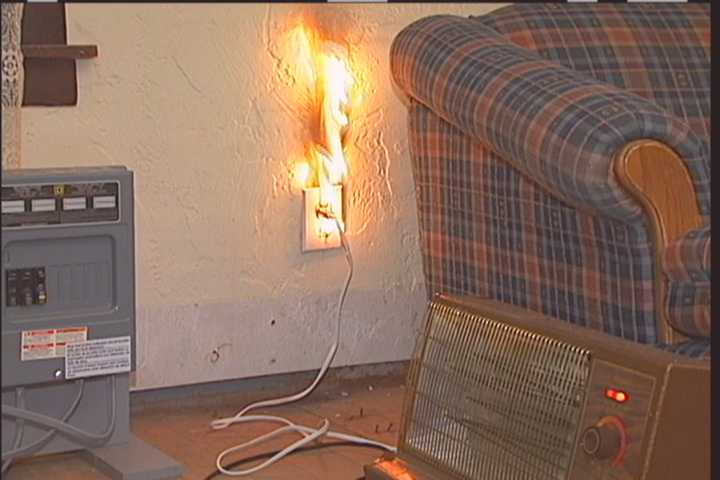
  • Heating equipment was the leading cause of reported home fires in the 1980s and has generally ranked second since them.  It is the second leading cause of home fire deaths. Fires involving heating equipment peak in December, January and February, as do deaths from these fires.
  • The leading factor contributing to heating equipment fires was failure to clean, principally creosote from solid fueled heating equipment, primarily chimneys.
  • Portable or fixed space heaters, including wood stoves, were involved in one-third (32%) of home heating fires and four out of five (79%) home heating deaths.
  • Half of home heating fire deaths resulted from fires caused by heating equipment too close to things that can burn, such as upholstered furniture, clothing, mattresses or bedding.

(Google Image) 

Smoking Materials
  • In 2010, smoking materials started and estimated 17,500 home structure fires, resulting in 540 deaths, 1,320 injuries and $535 million in direct property damage. Smoking materials are the leading cause of home fire deaths.
  • Sleep was a factor in two of every five home smoking material fire deaths. Possible alcohol impairment was reported in one quarter of these deaths.
  • In recent years, Canada and the United States have required that all cigarettes sold must be “fire safe,” that is have reduced ignition strength and less likely to start fires.

(Google Image) 

Electrical
  • Half (49%) of home electrical fires involved electrical distribution or lighting equipment. Other leading types of equipment were washer or dryer, fan, portable or stationary space heater, air conditioning equipment, water heater and range.
  • In 2010, electrical failures or malfunctions were factors in an estimated 46,500 home structure fires resulting in 420 deaths, 1,520 injuries and $1.5 billion in property damage.

(Google Image) 

Candles
  • On average, there are 35 home candle fires reported per day.
  • More than one-third of these fires started in the bedroom.
  • More than half of all candle fires start when things that can burn are too close to the candle.
  • In 2010, candles caused 3% of home fires, 4% of home fire deaths, 6% of home fire injuries and 5% of direct property damage from home fires.

(Google Image) 

Home Fire Sprinklers
  • Automatic fire sprinkler systems cut the risk of dying in a home fire by about 83%.
  • Home fire sprinklers can contain and may even extinguish a fire in less time than it would take the fire department to arrive on the scene.
  • Sprinklers are highly effective because they react so quickly in a fire. They reduce the risk of death or injury from a fire because they dramatically reduce the heat, flames and smoke produced, allowing people time to evacuate the home.


Be sure to download and print Sparky’s “Home Fire SafetyChecklist” and make sure your home is prepared.

Remember to be fire and safety aware everyday – if you see something that is a potential hazard – fix it then!

References and Links:


Sunday, July 17, 2011

First Aid Overview and Quiz


The definition of first aid is "the immediate care of the injured or ill". This could be a stranger, a family member or even yourself. To administer first aide one must know what to do and also just as important one must know what not to do. The whole object of first aide is to aid the injured or ill without ever doing harm.
The first and most important thing in first aide is to always prevent harm to yourself. Do not jump into a automobile without first making sure that there is no danger of fire or of the auto moving and causing you or another rescuer injury.

Remember these "ABCs" of first aid

A) Be sure that the person has an open Airway.

B) Secondly be sure that the person is Breathing. An open airway does not mean that the person is breathing. Everyone from young children to elderly adults should be trained in CPR. This training is given free of charge. Check with your local fire department for a location near you.

C) Check for proper Circulation. Check for signs of bleeding. Check for open wounds and for blood soaked clothes. Most bleeding can be temporarily controlled by applying direct pressure to the area. Once you have applied pressure to the area using a clean cloth or gauze pads or whatever you have at hand, do not remove the cloth or gauze from the wound. If it becomes blood soaked apply another pad over the soaked one and continue to apply pressure. In this day and age I would also advise any first aide person to wear gloves. There are a number of infections that can be transported via body fluids. These include AIDS as well as Hepatitis. Your welfare is to be considered before your patient's.

If you are coming to the aid of a victim of a fall or trauma type accident where the person has a deformity due to a broken bone(s), do not move the appendage that is involved. If you must splint the appendage, do so in the position found. Check for a pulse distal to the injury before splinting and check for a pulse after splinting. Distal is further from the heart than the fracture.

If the fracture is open and bleeding or bone is visible do not apply direct pressure. Cover the area with a clean dressing. Call 911 at once.

Anytime that a person is injured from a fall or a trauma, remember to keep the person still and hold the head in place. Do not allow the head to rotate. This one simple step may save the person’s life. Crouch or lay at the top of the patient and place your hands on both sides of the head. Hold firmly but gently. If the person is awake, talk to him (her) in a soft, even voice. Assure the patient that you are there to help until an ambulance arrives. Assure the patient that you will not leave him (her) alone. Comfort the patient with your voice. Have someone call 911 or yell for assistance. Do not release the head until trained help arrives.

Medical emergencies are not in the realm of most first aid rescuers. If you come on to a person that is unconscious or their level of consciousness is low, call 911. Assure that the person has an open airway and is breathing. Check for bleeding (circulation). What may have started out as a medical problem may turn into a trauma situation due to a fall or other accident brought on by a low level of consciousness. Look at the whole picture, not just what is obvious at first glance.
This is a very simple overview of only two types of situations that call for first aid intervention. Many courses can be taken through the Red Cross as well as other agencies. Learn what you can before the incident happens. The life you save maybe your loved one or even yourself. Don't wait. Learn first aid and CPR today.

First Aid Quiz


Happy Birthday Dad!

  October 15, 2023 Each day, I walk into my den to see what in new and what are my ‘to do’ items for the day and say good morning, Dad. This...