Showing posts with label Smoking. Show all posts

Friday, February 1, 2013

Heart Health Month


(Google Image)

By Nurse Diane

I've been doing alot of thinking about hearts lately.  Trying to design my Valentine's Day cards, deciding what kind of treats I want to fix for my family, thinking of people that I love, all these things come to my mind as Valentine's Day approaches.  I guess I am not alone when it comes to thinking about hearts this month.  That is why the American Heart Association has chosen February as Heart health Month.
(Google Image)
According to the CDC, Cardiovascular disease is the leading cause of death in the United States; one in every three deaths is from heart disease and stroke, equal to 2,200 deaths per day.  In November 2011, the Department of Health and Human Services launched a program called one Million Hearts.  The goal of this program is to prevent 1 million heart attacks over the next 5 years.  They are trying to raise awareness by promoting healthy food choices, encouraging exercises, teaching preventative measures such as stop smoking, and getting regular checkups and following your doctor’s orders.
(Google Image)
I have a friend who's heart is as big as Texas.  He has had health problems with his heart, and recently had a pacemaker inserted.  He is very cautious about his Dr's orders.  He eats properly; he takes his medications regularly, and exercises three days a week, well more than that normally.   He doesn't drink or smoke, and had cut down on his caffeine intake.  He is doing all he can to keep his heart healthy and functioning for a very long time.

Here are some recommendations from the CDC to keep your heart healthy:


  • Get up and get active by being physically active for at least 30 minutes on most days of the week.

  • Know your ABCS:

Ask your doctor if you should take an Aspirin every day.
Find out if you have high Blood pressure or Cholesterol, and if you do, get effective treatment.
If you Smoke, get help to quit.

  • Make your calories count by eating a heart-healthy diet high in fresh fruits and vegetables and low in sodium and Trans fat.

  • Take control of your heart health by following your doctor's prescription instructions.
(Google Image)


For more information about how to make your heart healthier, visit this site:

Tuesday, October 9, 2012

Fire Prevention Week and Month


(Google Image) 
By Terry Orr

“Fire! Fire! Fire! Class Alpha Fire in compartment 01-….” Hearing this announcement over the ships 1-MC (general announcement system) gets all hands immediate attention.  The other related announcement starts with “this is a drill, this is a drill…Fire….”  This is equally important as practice makes perfect (or nearly) and hones your firefighting skills.  For those who spend the days on land – they seldom if ever practice basic firefighting skills, understand the different types of fires, practice emergency exits, or know to prevent most fires. So set us start by taking a short fire prevention quiz.

(Google Image) 

Fast Facts About Fire
(From National Fire Protection Association)

(Google Image) 
Home Fires
  • One home structure fire was reported every 85 seconds in 2010.
  • Most fatal fires kill one or two people.  In 2010, 19 home fires killed five or more people. These 19 fires resulted in 101 deaths.
  • In 2010, U.S. fire departments responded to 369,500 home structure fires. These fires caused 13,350 civilian injuries, 2,640 civilian deaths, and $6.9 billion in direct damage.

(Google Image) 

Escape Planning 
  • According to an NFPA survey, only one-third of Americans have both developed and practiced a home fire escape plan.
  • Almost three-quarters of Americans do have an escape plan; however, less than half actually practiced it.
  • One-third of Americans households who made and estimate they thought they would have at least 6 minutes before a fire in their home would become life threatening. The time available is often less. And only 8% said their first thought on hearing a smoke alarm would be to get out!

(Google Image) 

Smoke Alarms
  • Almost two-thirds (62%) of reported home fire deaths resulted from fires in homes with no smoke alarms or no working smoke alarms.
  • Working smoke alarms cut the risk of dying in reported home fires in half.
  • In fires considered large enough to activate the smoke alarm, hardwired alarms operated 92% of the time, while battery powered alarms operated only 77%  of the time.

(Google Image) 

Cooking
  • Cooking has been the leading cause of reported home fires and home fire injuries since 1990. Unattended cooking was by far the leading cause of these fires; Two-thirds of home cooking fires began with ignition of cooking materials, including food, cooking oil, fat, or grease.
  • Cooking caused two of every five (42%)  of reported home fires, roughly one of every seven  (15% ) home fire deaths, and two of every five (37% ) home fire injuries, and 11% of direct property damage from home fires in 2010.
  • Ranges accounted for the 58% of home cooking fire incidents. Ovens accounted for 16%.
  • Children under five face a higher risk of non-fire burns associated with cooking than being burned in a cooking fire.
  • 90% of burns associated with cooking equipment resulted from contact with hot equipment or some other non-fire source.

(Google Image) 

Heating
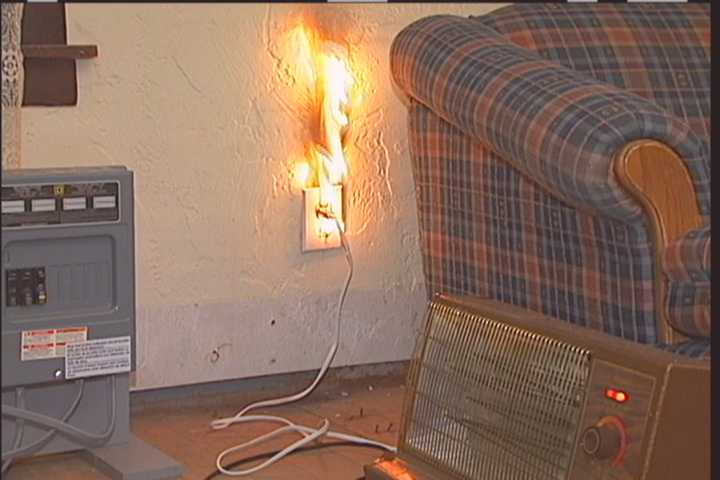
  • Heating equipment was the leading cause of reported home fires in the 1980s and has generally ranked second since them.  It is the second leading cause of home fire deaths. Fires involving heating equipment peak in December, January and February, as do deaths from these fires.
  • The leading factor contributing to heating equipment fires was failure to clean, principally creosote from solid fueled heating equipment, primarily chimneys.
  • Portable or fixed space heaters, including wood stoves, were involved in one-third (32%) of home heating fires and four out of five (79%) home heating deaths.
  • Half of home heating fire deaths resulted from fires caused by heating equipment too close to things that can burn, such as upholstered furniture, clothing, mattresses or bedding.

(Google Image) 

Smoking Materials
  • In 2010, smoking materials started and estimated 17,500 home structure fires, resulting in 540 deaths, 1,320 injuries and $535 million in direct property damage. Smoking materials are the leading cause of home fire deaths.
  • Sleep was a factor in two of every five home smoking material fire deaths. Possible alcohol impairment was reported in one quarter of these deaths.
  • In recent years, Canada and the United States have required that all cigarettes sold must be “fire safe,” that is have reduced ignition strength and less likely to start fires.

(Google Image) 

Electrical
  • Half (49%) of home electrical fires involved electrical distribution or lighting equipment. Other leading types of equipment were washer or dryer, fan, portable or stationary space heater, air conditioning equipment, water heater and range.
  • In 2010, electrical failures or malfunctions were factors in an estimated 46,500 home structure fires resulting in 420 deaths, 1,520 injuries and $1.5 billion in property damage.

(Google Image) 

Candles
  • On average, there are 35 home candle fires reported per day.
  • More than one-third of these fires started in the bedroom.
  • More than half of all candle fires start when things that can burn are too close to the candle.
  • In 2010, candles caused 3% of home fires, 4% of home fire deaths, 6% of home fire injuries and 5% of direct property damage from home fires.

(Google Image) 

Home Fire Sprinklers
  • Automatic fire sprinkler systems cut the risk of dying in a home fire by about 83%.
  • Home fire sprinklers can contain and may even extinguish a fire in less time than it would take the fire department to arrive on the scene.
  • Sprinklers are highly effective because they react so quickly in a fire. They reduce the risk of death or injury from a fire because they dramatically reduce the heat, flames and smoke produced, allowing people time to evacuate the home.


Be sure to download and print Sparky’s “Home Fire SafetyChecklist” and make sure your home is prepared.

Remember to be fire and safety aware everyday – if you see something that is a potential hazard – fix it then!

References and Links:


Wednesday, January 11, 2012

Cigarettes Are Hazardous to your Health (and mine)


(Google Image) 

By Akindman,
(Reformed Smoker)

I first began smoking in my early teens – when I could get a cigarette – and stated smoking full time during my senior year of high school.  It was the ‘cool’ thing to do then – friends, peers, parents, and grandparents set the example.  Over the years, I quit a couple times but finally stop for good on March 31, 1987 while returning from lunch when my good friend asked me when I was going to quit.  My reply was to throw away the pack and lighter in the nearest trash bin and never again lit another cigarette.

Twelve years later, my doctor showed me a recent x-ray of my lungs, scar tissue was still present.

In 1964, the U.S. Surgeon General Luther Terry issued the first government report saying that smoking is hazardous to your health.

It is estimated that smoking-related diseases cause more than 440,000 American deaths annually, and costs the United States over $150 billion each year in health care costs.

Here's help for sticking to your New Year's resolution to quit in 2012:
  • National Cancer Institute's quit smoking line 1-877-44U-QUIT ( 1-877-448-7848 )
  • Smokefree.gov's Quit Guide
  • Live help via chat, from the National Cancer Institute, available Monday through Friday 8 a.m. until 11 p.m.


If you or someone you know is still smoking, please read this article – ‘Smoking – health risks’, Reviewed by Dr Patricia Macnair, GP http://www.netdoctor.co.uk/health_advice/facts/smokehealth.htm

(Google Image)

(Google Image)

(Google Image)

(Google Image)

(Google Image)
Message Received?

Wednesday, November 16, 2011

Great American Smokeout

(Google Image)


By Diane Forrest, RN

In 1970 in Randolph, Massachusetts, Arthur P. Mullaney suggested people give up cigarettes for one day and donate the money to the local high school.  In 1974, a "Don't Smoke Day" (or "D-Day") was promoted by Lynn R. Smith of the Monticello Times in Monticello, Minnesota.  On November 18, 1976, the California Division of the American Cancer Society successfully prompted nearly one million smokers to quit for the day. That California event marked the first Smokeout.

(Google Image)

Every year, the third Thursday in November, the nation's Great American Smokeout is held.  Smokers are encouraged to stop smoking for one day in hopes of stopping for a life time.

  • It wasn't that long ago when smoker's used to smoke at work, in restaurant’s, and airplanes.  Watching actors on television and in movies was a common sight.
  • Because of the efforts of individuals and groups that have led anti-tobacco efforts, there have been significant landmarks in the areas of research, policy, and the environment:
  • In 1977, Berkeley, California became the first community to limit smoking in restaurants and other public places.
  • In 1983, San Francisco passed the first strong workplace smoking restrictions, including bans on smoking in private workplaces.
  • In 1990, the federal smoking ban on all interstate buses and domestic flights of six hours or less took effect.
  • In 1994, the state of Mississippi filed the first of 24 state lawsuits seeking to recuperate millions of dollars from tobacco companies for smokers' Medicaid Bills.
  • In 1999, the Department of Justice filed suit against cigarette manufacturers, charging the industry with defrauding the public by lying about the risks of smoking.
  • In 1999, the Master Settlement Agreement (MSA) was passed, requiring tobacco companies to pay $206 billion to 45 states by the year 2025 to cover Medicaid costs of treating smokers. The MSA agreement also closed the Tobacco Institute and ended cartoon advertising and tobacco billboards.
  • In 2009 "The Family Smoking Prevention and Tobacco Control Act" was signed into law and gives the FDA the authority to regulate the sale, manufacturing, and marketing of tobacco products and protects children from tobacco industry’s marketing practices.

Quitting is hard, but you can increase your chances of success with help. The American Cancer Society can tell you about the steps you can take to quit smoking and provide the resources and support that can increase your chances of quitting successfully.

To learn about the available tools, call the American Cancer Society at 1-800-227-2345.

(Google Image)

Wednesday, November 9, 2011

Lung Cancer Awareness Week and Month

(Google Image) 


By Akindman

Lung cancer is the leading cause of cancer death for both men and women.

More people die of lung cancer than of colon, breast, and prostate cancers combined. The best way to prevent lung cancer is not to smoke and to avoid people who do. There are people who have been diagnosed with cancer who have never smoked.  Unfortunately, it is not possible to prevent all cases of lung cancer.

(Google Image) 

What is Lung Cancer?
Lung cancer is the uncontrolled growth and spread of abnormal cells in the lungs.  There are two types of lung cancer, non-small cell and small cell.  Non-small cell lung cancer grows and spreads slowly.  Small cell lung cancer grows more quickly and is more likely to spread to other organs in the body.

Risk Factors
  • Smoking cigarettes, cigars and/or pipes
  • Environmental Tobacco Smoke (ETS) or Secondhand Smoke
  • Radon exposure
  • Asbestos exposure
  • Continued exposure from diesel and other fossil fuels
  • Lung diseases
  • Family history


Symptoms
  • Persistent cough that gets worse over time
  • Constant chest pain
  • Coughing up blood
  • Shortness of breath, wheezing or hoarseness
  • Repeated problems with pneumonia or bronchitis
  • Swelling of the neck and face
  • Loss of appetite or weight loss
  • Fatigue


(Google Image) 

See your doctor if you have any symptoms or notice unusual changes in your health.

Happy Birthday Dad!

  October 15, 2023 Each day, I walk into my den to see what in new and what are my ‘to do’ items for the day and say good morning, Dad. This...