Showing posts with label Tornado's. Show all posts

Thursday, July 14, 2011

Tornado Safety Precautions

Wonder if her mother knows where she was?


What is a tornado?

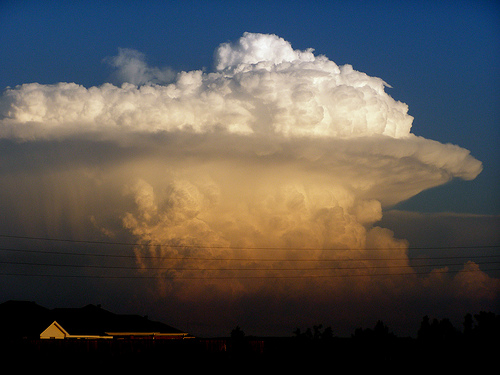
A tornado is the most violent atmospheric storm. A tornado is defined as a violently rotating column of air extending from a thunderstorm to the ground. The most violent tornadoes are capable of tremendous destruction with wind speeds of 250 mph or more.  Damage paths can be in excess of one mile wide and 50 miles long. 
Two times the fun ...NOT


Forget The Wizard of Oz notion that "twisters" only happen in Kansas. Tornados have been reported in every state. And while they generally occur during spring and summer, they can happen anytime during the year. With winds swirling at 200 miles an hour or more, a tornado can destroy just about anything in its path. Generally, there are weather signs and warnings that will alert you to take precautions. Be prepared by having various family members do each of the items on the checklist below. Then get together to discuss and finalize your Home Tornado Plan.

Plan and get ready: Pick a safety spot in your home where family members could gather during a tornado. (If you have a basement, make it your safety spot.) Make sure there are no windows or glass doors in the area. Keep this place uncluttered. If you live in a mobile home, choose another safety spot in a sturdy, nearby building.


http://www.redcross.org/www-files/Documents/pdf/Preparedness/checklists/Tornado.pdf

We can not stress strong enough the need to practice your plans for nasty weather.  Be prepared!  Thanks

Wednesday, July 13, 2011

Thunderstorms and Lighting


All thunderstorms produce lightning and are dangerous. If you can see lightning you are close enough to be struck. Lightning can occur as far as 10 miles away from any rainfall and is responsible for killing more people than tornadoes each year. Other dangers associated with thunderstorms include flash flooding, strong winds (i.e. straight-line winds), hail, wildfires, and tornadoes.

Then a thunderstorm is in your area:

  • Stay away from glass doors and windows.
  • Move to a basement or interior room in the house.
  • Keep outdoor objects secure that could become projectiles, such as lawn chairs, trash cans and toys.
  • Close window blinds, shades or curtains to buffer any glass breakage or flying debris.
  • Listen to a NOAA Weather Radio, or local radio and TV broadcasts for storm updates.
  • Assemble a family preparedness kit and create your emergency plan that designates a place for your family to meet both in and outside your immediate neighborhood should you become separated.
  • For more information about Thunderstorms & Lightning, http://www.nssl.noaa.gov/primer/tstorm/tst_basics.html


Facts About Thunderstorms
  • They may occur singly, in clusters, or in lines.
  • Some of the most severe occur when a single thunderstorm affects one location for an extended time.
  • Thunderstorms typically produce heavy rain for a brief period, anywhere from 30 minutes to an hour.
  • Warm, humid conditions are highly favorable for thunderstorm development.
  • About 10 percent of thunderstorms are classified as severe—one that produces hail at least three-quarters of an inch in diameter, has winds of 58 miles per hour or higher, or produces a tornado.

Facts About Lightning
  • Lightning’s unpredictability increases the risk to individuals and property.
  • Lightning often strikes outside of heavy rain and may occur as far as 10 miles away from any rainfall.
  • "Heat lightning" is actually lightning from a thunderstorm too far away for thunder to be heard. However, the storm may be moving in your direction!
  • Most lightning deaths and injuries occur when people are caught outdoors in the summer months during the afternoon and evening.
  • Your chances of being struck by lightning are estimated to be 1 in 600,000, but could be reduced even further by following safety precautions.
  • Lightning strike victims carry no electrical charge and should be attended to immediately.
Mother Nature's Light Show


Tuesday, May 24, 2011

Tornado Update


Last night Diane and I were chatting about the most recent outbreak of tornados across the country and felt that an update to our two earlier articles (April 16 and 30) was needed. During my research this morning I found this information on Wikipedia which provided a nice recap of the past two months. In addition, located a good preparedness article:

April 2011 was the most active month on record, capped by an extreme tornado outbreak that killed over 340 people in the final week. By contrast, the first three weeks of May were remarkably quiet with no major outbreaks and only isolated tornadoes. However, that pattern abruptly changed as a strong low pressure area and associated dry line and cold front tracked eastward.


EF3 tornado that struck Reading, Kansas


On May 21, a small system of thunderstorms began to develop in Brown County, Kansas. At the same time, another system formed to the southeast of Emporia, Kansas. The Brown county system developed into a tornado over Shawnee County, Kansas, and touched down over Topeka, Kansas, for several seconds causing minor damage nearby. Meanwhile the Emporia system continued to move to the northeast, where an EF3 (Enhanced Fujita Scale) tornado heavily damaged the town of Reading, Kansas. One person was killed there, several others were injured and at least 20 houses were destroyed. After hitting Topeka it hit several towns including Oskaloosa, Kansas, doing extensive damage to that community. Several other tornadoes touched down in the region that evening.


A moderate risk of severe weather was issued for much of the Midwest south to Oklahoma for May 22. The first tornadic supercell that day developed in the mid-afternoon hours over the western Twin Cities with a swath of damage, especially in and around Minneapolis, Minnesota. An intense tornado also tracked towards Harmony, Minnesota, that afternoon and a tornado emergency was issued. Late that afternoon, a very large and intense multiple-vortex tornado resulted in catastrophic damage in Joplin, Missouri EF-4). It was the deadliest single tornado in the U.S. since at least 1953.


Once again, a moderate risk of severe weather was issued for two regions on May 23 - the southern Plains and the lower Great Lakes - although the tornado threat was lower with the main threats being damaging wind and large hail. Such was also issued for May 24 across the southern Plains, centered around eastern Oklahoma, with strong to violent tornadoes considered to be a major threat.


Please join us in keeping these folks in our thoughts and prayers and give generously, if you can, to the American Red Cross (http://www.redcross.org/).


We will continue to monitor this year's tornado season and provide updates as needed. With regard to preparedness, this week in Hurricane Preparedness Week and we will post an article this week.


Almost a post script...the weather folks are predicting more severe storms today and tomorrow in many of the same areas hit since this past weekend.

Saturday, April 30, 2011

Tornado's - Deadly Storms Hit the South

We mourn for those who lost family and friends, homes, property during these series of deadly storms; you are in our thoughts and prayers.

Reading the accounts, watching the news, looking at still pictures and watching videos of the swath and aftermath is hard to imagine for many who have never been in a tornado.  The 1996 movie "Twister" with Helen Hunt and Bill Paxton provided excellent documentation and video of just how dangerous these storms can be and can happen any time day or night.

I remember one winter, that a Tornado touched down in Illinois, during a snow thunder storm killing several people and leaving hundreds homeless.  I asked my Dad, how will they survive in cold and the snow.  I had never heard of them and he explained that a twister can happen at anytime.

EF-5 Tornado’s hit Deep South, first EF-5 in three years.  So what does EF-5 mean?


In our earlier article on Tornado’s (http://kisbyto.blogspot.com/2011/04/tornados-often-referred-to-as-twister.html) we discuss what they are, what to do during a tornado, and to know where you should go for protection.

I grew up in the mid-west and tornado’s were just another fact of live you learn to deal with them. We had a basement in most of our homes and the southwest corner was always kept clean for that reason.  Flash lights, bottles of water, transistor radio, blankets, first aide kits, matches and lots of batteries are always on hand. .If someone yells “HAIL” in our home, there is a mad rush to the basement by everyone, including our cats.

The recent outbreak of tornados really brings home the need for everyone to be prepared, regardless of where you live or are, to know where to go in the event of sever storms.

Happy Birthday Dad!

  October 15, 2023 Each day, I walk into my den to see what in new and what are my ‘to do’ items for the day and say good morning, Dad. This...