Showing posts with label Social. Show all posts

Monday, July 1, 2013

SOCIAL WELLNESS


By Terry Orr


“Health is a state of complete physical, mental and social well-being, and not merely the absence of disease or infirmity.” ~World Health Organization, 1948


“Wellness is the conscious and deliberate process by which people are actively involved in enhancing their well-being: intellectual, physical, social, emotional, occupational and spiritual” ~ Hatfield

Social Wellness (family, community and environment) – focuses on how you choose to define and connect with your community and the people around you. 


Physical –your body's health, which involves nutrition, exercise, promoting over-all safety and wellness, and preventing physical illness.
Spiritual (values and ethics) – to understanding your place and purpose, how you make meaning of what happens to you, and what your mind goes to for comfort and relief.
Intellectual – means feeling stimulated and engaged with learning and staying open to new ideas and perspectives.
Emotional involves being aware of and managing your feelings, being at peace with who you are, and having the tools you need to weather life’s ups and downs.
Occupational – is the work you choose to do and how you feel it contributes to your community and fulfills you.

According to Work Smart. Life Smart –

July is Social Wellness Month and it reminds us that we need to reach out to others and build stronger social ties with family and friends. Social Wellness encourages us to develop better communications with those around us including the ability to share our feelings and needs. It involves respecting yourself and others and developing a solid social support system.

Social Wellness takes planning and effort to carve out time for those activities, as they may not happen naturally in today’s hectic world. We know from our research that socially isolated people are more susceptible to illness and have a death rate two to three times higher than those who are not socially isolated.  However people who maintain their social network and support systems do better under stress and are physically and mentally healthier.  They even achieve higher grade point averages.


So how important in Social Wellness in our daily life – one indication is the explosion of social media over the past decade.  According to eBizMBA the three top Social Media Sites (Facebook, Twitter and LinkedIn) average about 1.1 Billion visits each month – that is nearly one in seven people globally.  Folks reaching out to others – finding common ground – communicating – sharing – building relationships – a virtual family/home.


What we are all looking for – is balance in our lives – while sounding fairly straight forward – with our daily lives, most folks deal with the ever increasing demands on their time – and finding true balance is all to often is simply not possible.  The challenge is to prioritizes things best we can – and review what really and truly are the important things in our lives.


References and Links:


(Photos from Google)

Saturday, February 9, 2013

National Bullying Day - February 9, 2013


(Google Image)

By Terry Orr
Understanding that bullies (and imitators) have been around for ages – they need to be dealt with immediately – hopefully in a positive and corrective manner.  It has been my misfortune to have been around them since grade school, while in the military and during my consultant careers. All too often, the apple does not fall far from the tree.  This cycle truly needs to be broken.

Last February, we shared information regarding reporting bully behaviors to appropriate officials; educating kids about bullies early on; what to do when someone is being bullied; and working to  prevent bullying.
(Google Image)
What Is Bullying?
Bullying is behavior that hurts or harms another person physically or emotionally. Bullying can be very overt, such as fighting, hitting or name calling, or it can be covert, such as gossiping or leaving someone out on purpose. It is intentional, meaning the act is done willfully, knowingly and with deliberation. The targets have difficulty stopping the behavior directed at them and struggle to defend themselves. [Source: phillyBurbs.com]
(Google Image)
Facts that everyone should know about bullying:
71 percent of students report incidents of bullying as a problem at their school.
90 percent of 4th through 8th graders report being victims of bullying.
Every day, 160,000 students skip school because they are afraid they will be bullied.
The most common reason cited for being harassed is a student's appearance or body size. Two out of five teens feel that they are bullied because of the way that they look.
57 percent of students who experience harassment in school never report the incident to the school. Ten percent of those who do not report stay quiet because they do not believe that teachers or staff can do anything. As a result, more than a quarter of students feel that school is an unsafe place to be.
Nine out of 10 LGBT youth reported being verbally harassed at school in the past year because of their sexual orientation.
41 percent of principals say they have programs designed to create a safe environment for LGBT students, but only 1/3 of principals say that LGBT students would feel safe at their school.
One in four teachers see nothing wrong with bullying and will only intervene 4 percent of the time.
A victim of bullying is twice as likely to take his or her own life compared to someone who is not a victim.
Only one in 10 victims of cyberbullying tell a parent. Fewer than one in five cyberbullying incidents are reported to the police.
25% of bullies have a criminal record by the age of 30
Bullying is the most common form of violence in our society
25% of teachers see nothing wrong with bullying or putdowns and consequently intervene in only 4% of bullying incidents. [This fact is terrible truth.]

(Google Image)
Types of Bullying
Verbal bullying is saying or writing mean things. Verbal bullying includes: Teasing; name-calling; inappropriate sexual comments; taunting; and threatening to cause harm.

Social bullying, sometimes referred to as relational bullying, involves hurting someone’s reputation or relationships. Social bullying includes: Leaving someone out on purpose; telling other children not to be friends with someone; spreading rumors about someone; and embarrassing someone in public.

Physical bullying involves hurting a person’s body or possessions. Physical bullying includes: Hitting/kicking/pinching; spitting; tripping/pushing; taking or breaking someone’s things; and making mean or rude hand gestures.

Cyber bullying this type of bullying can be chat rooms, online, instant messaging, on a mobile phone; social networks; and e-mails
(Google Image)
What needs to be done?
Early intervention: Researchers advocate intervening in elementary or middle school, or as early as preschool. Group and building-wide social skills training is highly recommended, as well as counseling and systematic aggression interventions for students exhibiting bullying and victim behaviors.
Parent training: Parents must learn to reinforce their children’s positive behavior patterns and model appropriate interpersonal interactions.
Teacher training:  Training can help teachers identify and respond to potentially damaging victimization as well as to implement positive feedback and modeling to address appropriate social interactions.
Attitude change:  Researchers maintain that society must cease defending bullying behavior as part of growing up or with the attitude of “kids will be kids.” Bullying can be stopped!
Positive school environment: Schools with easily understood rules of conduct, smaller class sizes and fair discipline practices report less violence.

We as parents, guardians, members of the community – together need to work together to reduce bullying and that it is not acceptable behavior – regardless of ones age.
(Google Image)

References and Links:

Tuesday, October 2, 2012

Head Start Program – Is it Worth the Cost?


Head Start Awareness Month

(Google Image) 
By Terry Orr
Overview
Like most of us, we have heard many things about the Head Start Program (HSP) – the good, the bad and of course the ugly.  The concept and overall purpose of HSP is excellent – the implementation however, seems to be the problem. What follows is a summary of HSP today and recommendations on what may need to be done.

(Google Image) 

What is Head Start Program?
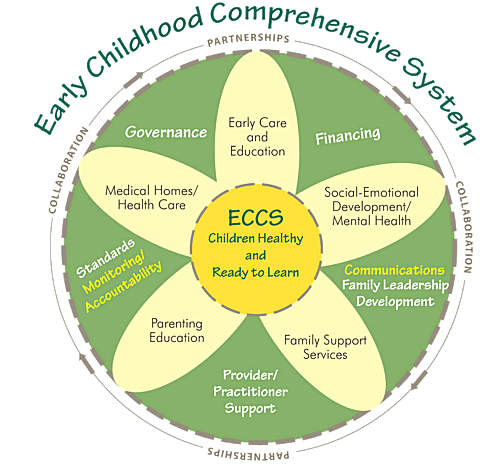
The Head Start Program is a program of the United States Department of Health and Human Services that provides comprehensive education, health, nutrition, and parent involvement services to low-income children and their families. (Wikipedia - also for more details)

Mission
Head Start promotes school readiness by enhancing the social and cognitive development of children through the provisions of education, health, nutrition, social and other services. [Source]

Other Services
Head Start and Early Head Start programs offer comprehensive, interdisciplinary services in the areas of physical and dental health, mental health, nutrition, education, and parent involvement.


Purpose

(Google Image) 
According to the Nevada Early Childhood Advisory Council:
President Ronald Reagan proclaimed October as Head Start Awareness Month in October of 1982. After 29 years, Head Start is proud to have served millions of low-income preschool children and their families.

Head Start strives to improve the prevention, detection and treatment of children’s medical, nutritional and educational problems. 


(Google Image) 
Budget and Funding
This is a tough one to decipher – from the Federal budget for 2012; about $8 billion was set aside for this program.  Other funding comes for states, corporation and personal donations.  Those numbers seemed reasonable for about one million children for the year.  Overall cost per child is around $8,000 per year (Multiple sources).  As of this writing, I have yet to uncover what is the total Head Start Program budget.

The Congressional Budget Office estimated last year that the automatic cuts would slice $590 million from federal spending on Head Start, which will be more than $7.9 billion in 2012. The National Education Association said the cuts would eliminate 80,000 of the 962,000 slots for children and more than 30,000 jobs of teachers, aides and administrators in the program. [Head Start Fears Impact of Potential Budget Cuts - By ADESHINA EMMANUEL – New York Times, Published: July 26, 2012].

(Google Image) 

Critical Studies and Statements
The Head Start Impact Study Final Report, Executive Summary dated January 2010 provides this final assessment.
In sum, this report finds that providing access to Head Start has benefits for both 3-year-olds and 4-year-olds in the cognitive, health, and parenting domains, and for 3-year-olds in the social-emotional domain. However, the benefits of access to Head Start at age four are largely absent by 1st grade for the program population as a whole. For 3-year-olds, there are few sustained benefits, although access to the program may lead to improved parent-child relationships through 1st grade, a potentially important finding for children’s longer term development.

Mr. McCluskey of the Cato Institute said, however: “The question shouldn’t ultimately be are some people helped. The question is, is the program doing the thing it’s supposed to do and doing it in a way that justifies the expense.  He continued: “If the goal is to give low-income students a head start, and it’s not providing that, then it’s not doing the job it exists to do. As a practical matter, there’s no evidence it’s working and it costs billions?” [Head Start Fears Impact of Potential Budget Cuts - By ADESHINA EMMANUEL – New York Times, Published: July 26, 2012].

(Google Image) 

My take on Head Start Program
First and foremost, I am not a subject matter expert on this topic.  From my layman’s perspective, this is another example of a well-meaning program that has grown significantly, whose purpose, goals and charter were expanded in the good fiscal times and now there are serious shortfalls in funding and HSP cannot meet existing obligations.

As a parent, grandparent and American citizen – doing what we can to help every American kid, especially education – is a high priority.  I stress the American kids here and not those who are in the country without proper documentation (illegal immigrants) – that in and of itself continues to strain our overall economy.

Final note – If Head Start Programs are to continue – a thorough review needs to be conducted – updating the mission and purpose of HSP.  Establish realistic budget and priorities for austere times.  Budget submission linked directly to federally mandated charter and HSPs strategic and business plans.

What Can You Do?
This largely depends on your perspective and support of Head Start.  If you support the programs - then getting involved, volunteering, donating money and or goods, and being proactive are good starting points.  In addition, I would think getting involved by encouraging others to participate and to contact their local, state and national elected people.

Questions

  • How and where does Head Start Programs fit into the overall Education big picture?
  • Does HSP really belong under the Welfare umbrella?
  • Where does education fit on your priority list?


Summary

  • Education of our children MUST take priority over many programs/expenses
  • Education today is failing to prepare our children for today's and tomorrows environment
  • Our Children need to be engaged in learning well before their 5th or 6th birthdays
  • We need world-class education from the ground up

(Google Image
References and Links:


Tuesday, February 15, 2011

Healthy Habit # 4 Make Social Connections

When I first read this one, it stopped me in my tracks a bit.  In todays cyber explosion, cell phone, chats, face-to-face, skype, and all the other means of communications, if folks are doing that, are they active in their communities? Church? 
After a few minutes of thinking about this, I got my trusty pencil and a pad of paper and started jotting things down off the top of my head.  What social connections am I making now that I am retired?
  • I spend more time talking with folks in the stores, post office, shops, etc
  • I’ve gotten to know the folks who take good care of me at the various restaurants
  • I send more emails, chat all to often, and call more folks
  • Taking more time to visit others in different cities
  • Spending more time with family and friends 
Providing information, instrumental help, emotional support, and offering a sense of belonging were the key benefits from the article on WebMD.
How do you make social connections?

Happy Birthday Dad!

  October 15, 2023 Each day, I walk into my den to see what in new and what are my ‘to do’ items for the day and say good morning, Dad. This...