Showing posts with label WHO. Show all posts

Sunday, April 7, 2013

World Health Day - High Blood Pressure


By Nurse Diane

World Health Day is celebrated on 7 April to mark the anniversary of the founding of World Health Organization (WHO) in 1948. Each year a theme is selected for World Health Day that highlights a priority area of public health concern in the world.  The theme for 2013 is High Blood Pressure.

High blood pressure – also known as raised blood pressure or hypertension – increases the risk of heart attacks, strokes and kidney failure. If left uncontrolled, high blood pressure can also cause blindness, irregularities of the heartbeat and heart failure. The risk of developing these complications is higher in the presence of other cardiovascular risk factors such as diabetes. One in three adults worldwide have high blood pressure. The proportion increases with age, from 1 in 10 people in their 20s and 30s to 5 in 10 people in their 50s. Prevalence of high blood pressure is highest in some low-income countries in Africa, and with over 40% of adults in many African countries.

The risk of developing high blood pressure can be reduced by:
  • Reducing salt intake;
  • Eating a balanced diet;
  • Avoiding harmful use of alcohol;
  • Taking regular physical activity;
  • Maintaining a healthy body weight; and
  • Avoiding tobacco use.


The ultimate goal of World Health Day 2013 is to reduce heart attacks and strokes. Specific objectives of the campaign are:
  • To raise awareness of the causes and consequences of high blood pressure;
  • To provide information on how to prevent high blood pressure and related complications;
  • To encourage adults to check their blood pressure and to follow the advice of health-care professionals;
  • To encourage self-care to prevent high blood pressure;
  • To make blood pressure measurement affordable to all; and
  • To incite national and local authorities to create enabling environments for healthy behaviors.

 (All images from Google) 

Friday, March 1, 2013

Celebrating Dr. Seuss


By Diane Forrest

When my son turned 16, I threw a Sweet 16 party for him at our church, with a Dr. Seuss theme. I had found hats for everyone, decorations, and a large selections of books on eBay to decorate the tables with.  My son loved Dr. Seuss from a very early age, and I thought it would be a nice passage to the way to adulthood.  My mother ridiculed me for my choice, however unbeknownst to me, Dr. Seuss was also the years homecoming theme, and the party was a huge success!

Dr. Suess has made an impact on every child's life which is why it is fitting to have him kick off the Read across America Day.  This is also Theodore Giselle's (Dr. Seuss) birthday. Kids and even grown up's love the rhyming and funny adventures from his books, many college students are given a copy of "Oh the Places You'll Go" when they graduate high school or college.

From the Cat in the Hat, to the Grinch, to the Horton who hears a "Who", not only do his books inspire children to read, but they also teach about the rules of life, and how to live right.

Today is Dr. Seuss Day, and here are some of my favorite quotes leave us a comment and let us know about your favorite Dr. Seuss story:

“Don't cry because it's over, smile because it happened.”

“You have brains in your head. You have feet in your shoes. You can steer yourself any direction you choose. You're on your own. And you know what you know. And YOU are the one who'll decide where to go...”

“Today you are You, that is truer than true. There is no one alive who is Youer than You.”

“The more that you read, the more things you will know. The more that you learn the more places you'll go.”

“Why fit in when you were born to stand out?”

“So be sure when you step, Step with care and great tact. And remember that life's A Great Balancing Act. And will you succeed? Yes! You will, indeed! (98 and ¾ percent guaranteed) Kid, you'll move mountains.”

“Remember me and smile, for it's better to forget than to remember me and cry.”


[All images from Google]

Sunday, August 19, 2012

World Humanitarian Day 2012

(Google Image) 

By Terry Orr

“This year’s World Humanitarian Day presents an historic opportunity to bring together one billion people from around the world to advance a powerful and proactive idea: People Helping People. That is the best way to honour the many fallen aid workers we mourn today, and to celebrate the efforts of others who carry on their noble mission by rushing assistance to those who are suffering.”

Secretary-General Ban Ki-moon

Every day humanitarian aid workers help millions of people around the world, regardless of who they are and where they are. World Humanitarian Day is a global celebration of people helping people.

This year’s campaign "I Was Here" is about making your mark by doing something good, somewhere, for someone else.

(Google Image) 

The World Health Organization (WHO) states:

Natural disasters, conflicts and other emergencies threaten the lives and health of millions of people every year. In the middle of such crises, thousands of dedicated humanitarian workers strive to care for those who have been affected and support local authorities to deliver assistance. On World Humanitarian Day, WHO and other international bodies are highlighting the roles performed by humanitarian workers, and remembering aid workers who have been killed or injured while performing their vital roles.

World Humanitarian Day offers the chance:

  • for the public to learn more about the humanitarian community, what aid workers do and the challenges they face;
  • for nongovernmental and international bodies and UN agencies, to demonstrate their humanitarian activities;
  • to pay respect to those who have died or been injured in the course of their humanitarian work.

(Google Image) 

References and links:


Saturday, August 4, 2012

Immunization Awareness Month – 2012 Update


(Google Image) 

By Diane Forrest, RN

Have you been reading about the outbreak of whooping cough?  It appears that it is spreading again.  Why is this happening?  Isn't there a vaccine for that?  The trouble is some parents are choosing not to vaccinate their children.  Vaccination records were easy to obtain.  They have to be submitted before entering school. Another problem is, many families are choosing to homeschool their children, and some of those who homeschool do not vaccinate their children do to various beliefs.

National Immunization Awareness Month is the perfect time to promote immunizations and remind family, friends, and coworkers to get caught up on their shots.

(Google Image) 
Vaccinations are very important to control many diseases.  Take a look at Small pox.  This disease has been eradicated here in the US, and most other countries.  Thanks to WHO when they got the word out about vaccinations.

(Google Image) 
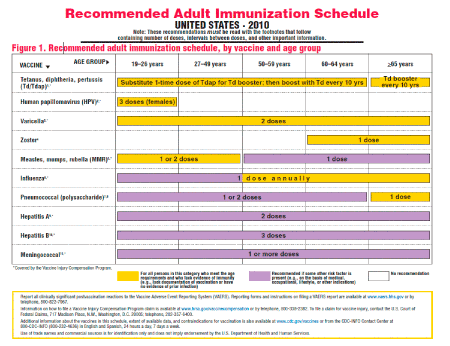
Vaccinations are not just for children, there are several vaccines available for adults as well.  Vaccines for the flu, shingles, tetanus, and other diseases.  A chart for adults is pictured above.
(Google Image) 
August is Immunization Awareness Month.  This month was chosen because children are starting school, or returning back to school and need to have their records, and updates.  It is also good times for adults who plan on traveling to get their records checked, and start appropriate shots.

If you have or know children who have not been immunized, please take them or encourage their parents to take proper measures to protect them from acquiring life threatening diseases.

(Google Image) 

What childhood vaccines are recommended, and at what ages they should be given?

Hepatitis B vaccine:
  • First dose at birth before discharge
  • Second dose at 1 to 2 months
  • Third dose at 6 to 18 months


HIB vaccine:
  • First dose at 2 months
  • Second dose at 4 months
  • Third dose at 6 months (depending upon type of Hib vaccine given)
  • Fourth dose at 12 to 15 months


Inactivated polio vaccine:
  • First dose at 2 months
  • Second dose at 4 months
  • Third dose at 6 to 18 months
  • Fourth dose at 4 to 6 years


DTaP vaccine:
  • First dose at 2 months
  • Second dose at 4 months
  • Third dose at 6 months
  • Fourth dose at 15 to 18 months
  • Fifth dose at 4 to 6 years
  • Tdap is recommended at 11 years


Pneumococcal vaccine:
  • First dose at 2 months
  • Second dose at 4 months
  • Third dose at 6 months
  • Fourth dose at 12 to 18 months


Rotavirus vaccine:
  • First dose at 2 months
  • Second dose at 4 months
  • Third dose at 6 months (depending upon type of rotavirus vaccine given)


Hepatitis A vaccine:
  • First dose at 12 months
  • Second dose at 18-30 months


Influenza vaccine:
  • First dose at 6 months (requires a booster one month after initial vaccine)
  • Annually until 5 years


MMR vaccine:
  • First dose at 12 to 15 months
  • Second dose at 4 to 6 years


Varicella vaccine:
  • First dose at 12 to 15 months
  • Second dose at 4 to 6 years


Meningococcal vaccine:
  • First dose at 11 years
  • Second dose at 16 years


Human papillomavirus vaccine:
  • First dose at 11 years
  • Second dose two months after first dose
  • Third dose six months after first dose


Links:


Friday, April 6, 2012

World Health Day


(Google Image) 

By Diane Forrest, RN

In 1948 the World Health Organization (WHO) held their first assembly and named April 7 as World Health day.  This marks the anniversary of the founding of WHO, and each year they focus on particular theme.  This year the theme is Aging and continuing good health.  People are becoming more aware of their health, and ways to make it better to live longer.    A major factor in achieving their goals is by diet, exercise and routine medical examinations.

(Google Image) 
World Health Day is a global observance and not a public holiday.  Various local, national and international events are arranged to educate the public and policy makers about a specific aspect of the World Health Organization's work.   World Health Day is a global campaign, inviting everyone – from global leaders to the public in all countries – to focus on a single health challenge with global impact. Focusing on new and emerging health issues, World Health Day provides an opportunity to start collective action to protect people's health and well-being.

(Google Image) 
For more information about World Health Day click on this site:  http://www.who.int/world-health-day/en/

(Google Image) 

Monday, October 10, 2011

The Great Push: Investing in mental health

By Akindman


The theme for Mental Health Day, 2011 is "The Great Push: Investing in mental health."
This year, the day hopes to enhance discussions on mental disorders, and to encourage investments in prevention, treatment and promoting awareness of mental illnesses.

What is Mental Health?

Sound mental health is not merely a reference to disease-free existence; it is a state of well-being when an individual is able to realize his, or her, full potential, is able to handle life’s stresses and is able to contribute positively towards society.

Mental illness is a universal malady. According to World Health Organization’s statistics for 2002, 154 million people across the globe suffer from depression.

Mental Health is an umbrella term referring to the diagnosis, treatment, prevention and rehabilitation of individuals with mental diseases.

This day promotes open discussion of mental disorders, and investments in prevention, promotion and treatment services. The treatment gap for mental, neurological and substance use disorders is formidable especially in poor resource countries.

Mental, behavioral and neurological disorders are common in all countries around the world, causing immense agony and staggering economic and social costs. People with any disorder are mostly subjected to an isolated social life, poor life quality and higher death rates.

Mental Health – Global Priority
Mental health is increasingly endorsed as a significant aspect in terms of the overall well-being of the individual. Mental health issues are a global priority and it is imperative to address issues pertaining to it at the earliest and in an effective and efficacious manner.

Integration of Mental Health into the Primary Care Setting
This day encourages more transparent discussion of illnesses, and investments in prevention and treatment services.
The World Health Organization has identified following 7 reasons for including mental health into the primitive care structure:
  • The burden of mental disorders is immense. They create a substantial personal burden for affected persons and their families, and they create magnificent economic and social hardships that affect the society entirely.
  • The treatment gap for mental disorders is huge. There is a substantial gap between the prevalence of mental disorders and the quantity of people undergoing treatment.
  • Mental and physical health issues are interlinked. Integrated primary care services affirm that people are provided with the fair treatment.
  • When mental health is clubbed with primary care, people can get mental health services close to vicinity. It also enhances mental health promotion and community outreach.
  • Primitive care for mental health attention is less expensive for patients, communities and governments alike.
  • Primary care for mental health dignifies respect of human rights.
  • Primary care for mental health asserts good health outcomes specifically when collaborate with a network of services at secondary stage and in the community.


Inclusion of mental health within the primitive care system can yield more fruitful results in following manners:
  • Diagnosing for mental disorders results in improved patient outcomes only when appropriate care detection is followed.
  • Increasing referrals to behavioral health provider specialist with added supports may lead to enhance follow-through and outcomes.
  • Imparting Physician education.
  • Care needs to be streamlined and based at evidence-based approaches.

Meanwhile it is imperative to ensure that there are clearly defined principles and steps regarding the line of treatment that should be offered to the general practitioners and primary care workers. Following the initial treatment by primary workers further referrals for complex mental health issues can be sent to psychiatrists and psychologists with specialization.

Polices Must be Designed and Implemented
Thus, policies are required to be structured and implemented by the government. This would mean that involvement of government is required and these problems need to be included into the health regulations of general nature which should be included with medical, physical, psychological and mental health concerns. Hence advocacy is required and it acts as an important aspect of mental health. We would need to sensitize the leadership, health institutions, organizations and primary care workers about the necessity of integration of these two aspects of health. This can be summarized as follows as has also been recommended by the WHO as guidelines for including mental health in primary care:
  • Plan and policy should be framed to implement primary care for mental health.
  • The changes should be properly advocated.
  • Adequate training needs to be imparted besides allocation of tasks that are important.
  • Sensitization at various levels is essential.
  • Collaboration is needed between government and NGOs to work in primary health care system.
  • There needs to be adequate earmarking of financial and human resources to ensure the availability of services to maximum number of individuals.

Interventions Needed
Simple and less expensive interventions should be provided with primary importance. Some of the interventions that need to be incorporated include:
  • Early intervention within schools by school counselors and pediatricians.
  • Provision of support to children through education and skill building programs.
  • Promotional event pertaining to mental health in schools.
  • Specialized support services for women and elderly that cater to their needs.


Community program to create awareness and remove trauma associated with mental health problems.
The identification of need for inclusion of services is specifically required within the context of a big and voluminous country where dearth of professionals leads to millions of people without treatment that they urgently require. A step in the direction of incorporation would be beneficial to all – patients, their families, mental health experts, medical experts, non-medical and non-governmental bodies working in the sector for the advocacy of the overall health and prosperity of the individual and hence the human race at large.


Happy Birthday Dad!

  October 15, 2023 Each day, I walk into my den to see what in new and what are my ‘to do’ items for the day and say good morning, Dad. This...