Showing posts with label Awareness. Show all posts

Friday, September 14, 2012

Ovarian Cancer Awareness Month

(Google Image) 

By Nurse Diane

Earlier this month we told you that is was gynecologic cancer awareness month.  Included in the group are Ovaries.  Ovarian Cancer is one of the most deadly of women's cancers. Each year, approximately 21,880 women will be diagnosed with ovarian cancer. In 2010, approximately 13,850 women will die in the United States from ovarian cancer. Many women don't seek help until the disease has begun to spread, but if detected at its earliest stage, the five-year survival rate is more than 93%. Recent research suggests that together the four symptoms of: bloating, pelvic or abdominal pain, difficulty eating or feeling full quickly and urinary urgency or frequency may be associated with ovarian cancer.  Below is a copy of the Presidential Proclamation:

NATIONAL OVARIAN CANCER AWARENESS MONTH, 2012

BY THE PRESIDENT OF THE UNITED STATES OF AMERICA
A PROCLAMATION
 

This year, thousands of American women will lose their lives to ovarian cancer. They are mothers and daughters, sisters and grandmothers, community members and cherished friends -- and the absence they leave in our hearts will be deeply felt forever. During National Ovarian Cancer Awareness Month, we honor those we have lost, show our support for women who bravely carry on the fight, and take action to lessen the tragic toll ovarian cancer takes on families across our Nation.
Sadly, women are all too often diagnosed with this disease when it has already reached an advanced stage. Because early detection is the best defense against ovarian cancer, it is essential that women know the risk factors associated with the disease. Women who are middle-aged or older, who have a family history of ovarian or breast cancer, or who have had certain cancers in the past are at increased risk of developing ovarian cancer. Any woman who thinks she is at risk of ovarian cancer or who experiences symptoms, including abdominal pain, pressure, or swelling -- should talk with her health care provider. To learn more, visit www.Cancer.gov.
Ongoing progress in science and medicine is moving us forward in the battle against ovarian cancer, and my Administration remains committed to improving outcomes for women suffering from this devastating illness. Through agencies across the Federal Government, we are continuing to invest in research that paves the way for a new generation of tests and treatments. Through the Centers for Disease Control's Inside Knowledge campaign, we are working to raise awareness about the signs and symptoms of ovarian cancer. The Affordable Care Act already bans insurance companies from dropping a woman's coverage because she has ovarian cancer, and from placing lifetime or restrictive annual dollar limits on her coverage. Beginning in 2014, the law will also prohibit insurers from denying coverage or charging higher premiums because a woman has ovarian cancer -- or any other pre-existing condition. 
 Ovarian cancer affects the lives of far too many women every year, and the tragedy it leaves in its wake reverberates in communities across our country. This month, we stand with all those who have known the pain of ovarian cancer, and we rededicate ourselves to the pursuit of new and better ways to prevent, detect, and treat this devastating disease.
NOW, THEREFORE, I, BARACK OBAMA, President of the United States of America, by virtue of the authority vested in me by the Constitution and the laws of the United States do hereby proclaim September 2012 as National Ovarian Cancer Awareness Month. I call upon citizens, government agencies, organizations, health care providers, and research institutions to raise ovarian cancer awareness and continue helping Americans live longer, healthier lives. I also urge women across our country to talk to their health care providers and learn more about this disease.
(Google Image) 
September is Ovarian Cancer Awareness Month.  I urge you to visit your gynecologist if you have not done so this year, and also encourage all the women in your life to be checked as well.  Early detection can provide a successful survival rate.

(Google Image) 

Sunday, September 9, 2012

Leukemia, Lymphoma and Myeloma Awareness Month

(Google Image) 

By Nurse Diane

I will never forget the summer of 1976.  That was the year my family moved to a different city.  We were frequently moving since my father's job kept promoting him and with each promotion came a new location. I was always excited to move to a new place meet new people and start a new school, but this summer was different.  Shortly after we moved, my mother got a phone call.  My grandfather was in the hospital, he had been diagnosed with Leukemia.  My mother left to be by his side, and to help my grandmother.  We, my brother, father and I were left at home to fend for ourselves.  I was a young girl at the time, and didn't really understand what was going on.  My grandfather was a very strong man.  He had served in 2 wars, and was a full time employee of the National Guard.  He was a very strict military man, and nothing could bring him down.  But my grandfather had never met cancer before.  Luckily, he did not suffer long with his illness. His death was fast and unexpected.  He outlived his mother, but passed away before seeing his youngest daughter get married.  He had a full military funeral, with a flag over his casket, bugles playing, and a 21 gun salute.  This was the first time I had experienced a death in my family, and it was all confusing. I wish I had more time to spend with him, to learn of his military career, and how he won the box full of medals that my father placed in a frame.
(Google Image) 
September is Leukemia, Lymphoma and Myeloma Awareness Month.  The Leukemia & Lymphoma Society (LLS) was founded in 1949. Blood cancers affect more than 912,000 people with 140,000 new diagnoses each year.  Each year around 53,000 die from blood cancers.  The Leukemia and Lymphoma Society has been dedicated to finding a cure for these diseases through voluntary contributions. The Leukemia & Lymphoma Society (LLS) is the world's largest voluntary health agency dedicated to blood cancer. The LLS mission: Cure leukemia, lymphoma, Hodgkin's disease and myeloma, and improve the quality of life of patients and their families. LLS funds lifesaving blood cancer research around the world and provides free information and support services.  Remarkable progress has been made in treating patients with blood cancers, with survival rates for many having doubled or tripled, and in some cases quadrupled.
(Google Image) 
If you know someone who is suffering from these blood cancers, and would like to help in finding a cure, please visit this website for more information about ways you can help. http://www.lls.org/#/waystohelp/donate/

Tuesday, August 28, 2012

National Sarcodosis Awareness Day

(Google Image) 

By Nurse Diane

In 1991 President George Bush issued a Proclamation declaring today as National Sarcodosis Day, here is an excerpt from that proclamation:

Sarcodosis, a disease that affects many of our fellow citizens and people around the world, remains shrouded in mystery. Skin-related symptoms of this chronic, multi-system disease were first recognized more than 100 years ago; however, the effects of Sarcodosis on other bodily organs were not observed until the first quarter of this century. Today researchers are still trying to learn more about the cause and the nature of this affliction. Sarcodosis can strike people of all races and of all ages, but, according to the United States Department of Health and Human Services, it is most common among black Americans who are between the ages of 20 and 40. While no cause has yet been identified, it is thought that heredity predisposes some individuals to the disease. Intensive research during the past decade has not only supported this belief but also enabled physicians to diagnose and to manage Sarcodosis more effectively.
(Google Image)
Today researchers at both the National Institute of Allergy and Infectious Diseases and the National Heart, Lung, and Blood Institute are leading studies on the etiology, diagnosis, and treatment of Sarcodosis. On this occasion, we recognize their work and that of other concerned physicians and scientists throughout the United States. We also salute the victims of Sarcodosis who demonstrate great courage and determination in their efforts to cope with the disease; and we pay tribute to their family members and to other concerned Americans who are engaged in grass-roots efforts to promote awareness of Sarcodosis, as well as improved treatment and support for its victims.

(Google Image)
Sarcodosis is a disease in which inflammation occurs in the lymph nodes, lungs, liver, eyes, skin, or other tissues.  Some causes include:
  • Extreme immune response to infection;
  • High sensitivity to environmental factors;
  • Genetic factors;
  • age, usually between the ages of 20 to 40 years old;
  • Affects women more than men; and or
  • Can occur if you have a close relative who suffers from Sarcodosis


Symptoms include chest pains, dry cough, shortness of breath, loss of appetite, general feeling of malaise, fever, hair loss, rash, and headaches or seizures.

Sarcodosis can be diagnoses through a physical exam, chest x-rays and blood work.  Many with Sarcodosis are not seriously ill, and will get better without treatment on their own in about 3 years.  For more serious conditions, they may be treated with immunosuppressant drugs.
(Google Image)
Today is National Sarcodosis Awareness Day.  To learn more about it or how you can help, click on this site. http://www.inspire.com/groups/stop-sarcoidosis/discussion/national-sarcoidosis-awareness-day-august-29-2009/

Monday, August 13, 2012

Spinal muscular atrophy (SMA) Awareness Month

(Google Image) 

By Nurse Diane

Spinal Muscular Atrophy (SMA) is a group of inherited diseases that cause muscle damage and weakness, which get worse over time and eventually lead to death.  This disease is mainly present at birth, but type II can be noticed anywhere from 6 months to 2 years of age.  Type III SMA can also be seen during adolescence, but types II and III are a milder form of the disease.
(Google Image) 
Infants born with SMA have very little muscle tone. Often is first felt in the shoulder and leg muscles. Weakness gets worse over time and eventually becomes severe.
(Google Image) 
Symptoms in an infant include:
  • Breathing difficulty, leading to a lack of oxygen
  • Feeding difficulty (food may go into the windpipe instead of the stomach)
  • Floppy infant (poor muscle tone)
  • Lack of head control
  • Little movement
  • Weakness that gets worse
  • Symptoms in a child:
  • Frequent, increasingly severe respiratory infections
  • Nasal speech
  • Posture that gets worse


There is no treatment yet for this disease.  Prognosis is usually about 2 or 3 years.  Death can occur from pneumonia or heart failure.

(Google Image) 
This month is Spinal Muscular Atrophy Awareness Month.  To learn what you can do to promote this disease and show support, click on this site:  http://www.fsma.org/Fundraising/AwarenessMonth/

Sunday, August 12, 2012

Lefty's Day 2012

(Google Image) 

By Terry Orr

Raising awareness in 2012 - Teacher training and the needs of left-handed children

(Google Image) 
August 13 is designated International Lefthanders Day by Lefthanders International. It was first observed 13 August 1976. As its name suggests, it is meant to promote awareness of the inconveniences facing left-handers in a predominantly right-handed world. It celebrates their uniqueness and difference, who are from seven to ten percent of the world's population. Many left-handed people are discriminated against today's society, and are forced to use right handed tools, drive on the right side of the road, and even get harassed. International Lefthanders Day is made to end this discrimination. (Wikipedia)

(Google Image) 
If you are a leftie, a "Southpaw", then National Left Hander's day is just for you. This day is meant to promote awareness of the inconveniences facing left handers in a predominantly right-handed world.
(Google Image) 
15 Left Handed Facts (from http://www.squidoo.com/left-handers-day)

Did you know:
  1. Left Hander's Day was started in August 13 1976 by Left Handers International.
  2. About 7 percent of the population is left handed.
  3. Lefties are also called "Southpaws".
  4. In twins, there is a high tendency for one to be left-handed.
  5. 1 in 4 Apollo astronauts were left-handed.
  6. 4 of the 5 original designers of the Macintosh computer were left-handed.
  7. Left-handers usually reach puberty 4 to 5 months after right-handers.
  8. George H.W. Bush, Bill Clinton, and Barack Obama are all left handed. Ronald Regan was left handed too.
  9. Pablo Picasso, Isaac Newton, Albert Einstein, Leonardo Di Vinci, and Michelangelo were also left handed.
  10. Right handed people use the left side of their brains. Left handed people use the right sides of their brains.
  11. Left handers tend to adjust quickly to seeing underwater.
  12. Right handers tend to chew food on the right side, left handers tend to chew on the left side.
  13. Albert Einstein was left handed.
  14. Left handed people who have higher I.Q.s tend to have an I.Q. of over 140.
  15. In some cultures it is impolite to touch your food with your left hand.

(Google Image) 

References and Links:


(Google Image) 

Saturday, August 11, 2012

It’s Youth Day

(Google Image) 

By Terry Orr

International Youth Day is a time to think about the different problems and challenges that face young people across the globe, such as malnutrition and disease. The purpose of this day is to raise awareness about the state of young people in each country.

(Google Image)
In 1999, the General Assembly of the United Nations declared August 12th to be International Youth Day through resolution 54/120. Their hope was that people would organize activities on this day that would educate the public about issues that involve youth. They also wanted to promote the World Programme of Action for Youth, created in 1995 to find solutions to these situations.

(Google Image)

Tuesday, August 7, 2012

Safe Toys – 2012 Update

(Google Image) 

By Terry Orr

Parents a special note just for you:

You are responsible for ensuring that the toys your children play with are safe!!

(Google Image) 
As adults we need to ensure that the toys we purchase and or provide children are safe for them to play with - Here are 10 tips from Gifts.com on How to Buy Safe Toys:
  1. Adhere to age guidelines indicated on the packaging.
  2. Do the toilet paper tube test, "anything that can pass through the tube is too small to be given to a child under 3."
  3. Check if a part can be bitten off or swallowed.
  4. Avoid toys that have a string, ribbon or chord longer than 6 inches.
  5. Make sure that the toy has a nontoxic, durable finish.
  6. Avoid toys with sharp points, edges, or breakable parts.
  7. For ride-on toys, make sure that it is sturdy and stable. Also, make sure that your child has the proper safety equipment to use it.
  8. Toys with a decibel level higher than 100 can be harmful to the child's hearing.
  9. Avoid toys that have shooting and throwing projectiles, it can cause injuries.
  10. Check the Consumer Products Safety Commission for announcement on recalled toys.


(Google Image) 
We should conduct periodic review of toys to ensure that they are in good order, age appropriate and still safe for our children.  I believe this should be done three or four times a year – especially before birthdays and holidays.

(Google Image) 
Keeping abreast of the latest news on toys may sound daunting, but with subscribing to some of the watchdogs internet websites and blogs – there will forward you emails alerts.  In your normal conversations with other parents this topic will probably also come up with a product has been recalled or someone is asking advice about new toys.

(Google Image) 
A final note on the topic of toys and safety – putting the toys away!  As a parent and grandparent this has been a pet peeve of mine for decades.  Stepping on or tripping over toys.
(Google Image) 
References and links:


Saturday, August 4, 2012

Immunization Awareness Month – 2012 Update


(Google Image) 

By Diane Forrest, RN

Have you been reading about the outbreak of whooping cough?  It appears that it is spreading again.  Why is this happening?  Isn't there a vaccine for that?  The trouble is some parents are choosing not to vaccinate their children.  Vaccination records were easy to obtain.  They have to be submitted before entering school. Another problem is, many families are choosing to homeschool their children, and some of those who homeschool do not vaccinate their children do to various beliefs.

National Immunization Awareness Month is the perfect time to promote immunizations and remind family, friends, and coworkers to get caught up on their shots.

(Google Image) 
Vaccinations are very important to control many diseases.  Take a look at Small pox.  This disease has been eradicated here in the US, and most other countries.  Thanks to WHO when they got the word out about vaccinations.

(Google Image) 
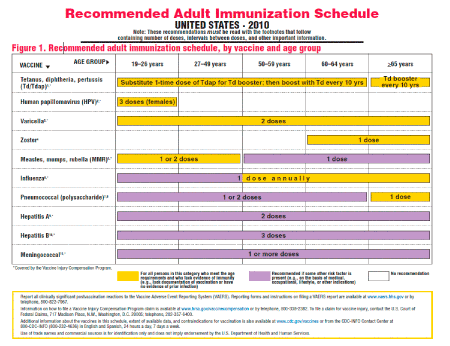
Vaccinations are not just for children, there are several vaccines available for adults as well.  Vaccines for the flu, shingles, tetanus, and other diseases.  A chart for adults is pictured above.
(Google Image) 
August is Immunization Awareness Month.  This month was chosen because children are starting school, or returning back to school and need to have their records, and updates.  It is also good times for adults who plan on traveling to get their records checked, and start appropriate shots.

If you have or know children who have not been immunized, please take them or encourage their parents to take proper measures to protect them from acquiring life threatening diseases.

(Google Image) 

What childhood vaccines are recommended, and at what ages they should be given?

Hepatitis B vaccine:
  • First dose at birth before discharge
  • Second dose at 1 to 2 months
  • Third dose at 6 to 18 months


HIB vaccine:
  • First dose at 2 months
  • Second dose at 4 months
  • Third dose at 6 months (depending upon type of Hib vaccine given)
  • Fourth dose at 12 to 15 months


Inactivated polio vaccine:
  • First dose at 2 months
  • Second dose at 4 months
  • Third dose at 6 to 18 months
  • Fourth dose at 4 to 6 years


DTaP vaccine:
  • First dose at 2 months
  • Second dose at 4 months
  • Third dose at 6 months
  • Fourth dose at 15 to 18 months
  • Fifth dose at 4 to 6 years
  • Tdap is recommended at 11 years


Pneumococcal vaccine:
  • First dose at 2 months
  • Second dose at 4 months
  • Third dose at 6 months
  • Fourth dose at 12 to 18 months


Rotavirus vaccine:
  • First dose at 2 months
  • Second dose at 4 months
  • Third dose at 6 months (depending upon type of rotavirus vaccine given)


Hepatitis A vaccine:
  • First dose at 12 months
  • Second dose at 18-30 months


Influenza vaccine:
  • First dose at 6 months (requires a booster one month after initial vaccine)
  • Annually until 5 years


MMR vaccine:
  • First dose at 12 to 15 months
  • Second dose at 4 to 6 years


Varicella vaccine:
  • First dose at 12 to 15 months
  • Second dose at 4 to 6 years


Meningococcal vaccine:
  • First dose at 11 years
  • Second dose at 16 years


Human papillomavirus vaccine:
  • First dose at 11 years
  • Second dose two months after first dose
  • Third dose six months after first dose


Links:


Saturday, July 7, 2012

Sandwich Generation Month


(Google Image) 

By Terry Orr

This is an annual commemoration and celebration of the dedication, patience and caring of adults who are part of the sandwich generation – those caring for their children as well as their own aging parents.
(Google Image) 
The annual recognition of Sandwich Generation Month is every July, with organizations and communities throughout the United States holding events to raise awareness of and provide support for members of the sandwich generation.  This time can be very stressful for those who are part of it. Every day presents new challenges for the Sandwich Generation and these people work very hard to ensure the safety and care of their loved ones.
(Google Image) 
Steve Worrall recommends the following steps:

Determine How You’ll Pay for Long-Term Care - Nursing home and assisted living facilities can cost up to $8,000 a month and Medicare will not pick up the tab.

Get The Legal Authority Now to Manage Their Affairs and Maintain Control - If your parents do not have powers of attorney or health care directives that allow you to communicate with doctors, access medical records and manage their financial affairs, it’s a good idea to create them now while mom or dad is still in good health.

Document Their End-of-Life Wishes - Thousands of families each year are torn apart trying to decide what their loved one “would have wanted” in serious medical situations.

Get Organized to Avoid Last Minute Scrambling - Gather your parent’s important information now to avoid any confusion and delays in the event of a medical emergency. Important documents to collect include insurance information, front and back of all ID cards including driver’s license, prescription cards and military ID cards, prior medical history, names and numbers of doctors, copies of their living will, health care directives and a list of current medication and doses.

(Written by Attorney Steve Worrall. For a copy of his Guide, “Surviving the ‘Sandwiched’ Years: How to Protect Your Parent’s Assets, Honor Their Wishes & Provide Long-Term Care . . . Without Losing Money – Or Your Mind!”, please visit www.GeorgiaSandwichGeneration.com.)

(Google Image) 
Links:


Wednesday, June 27, 2012

Potty Training Awareness Month - 2012


(Google Image) 

By Papa Orr

Potty training is a major milestone in a child’s life. For many parents, potty training is difficult.  So, in honor of Potty Training Awareness Month (June), we thought it would be the perfect time to share some information/tips to give you a better understanding of the basics of potty training.
(Google Image) 

Potty training: How to get the job done
Potty training is a major milestone. Get the facts on timing, technique and handling the inevitable accidents.

By Mayo Clinic staff
Potty training is a big step for kids and parents alike. The secret to success? Patience — perhaps more patience than you ever imagined.

Is it time?

Potty-training success hinges on physical and emotional readiness, not a specific age. Many kids show interest in potty training by age 2, but others might not be ready until age 2 1/2 or even older — and there's no rush. If you start potty training too early, it might take longer to train your child.

Is your child ready? Ask yourself these questions:

  • Does your child seem interested in the potty chair or toilet, or in wearing underwear?
  • Can your child understand and follow basic directions?
  • Does your child tell you through words, facial expressions or posture when he or she needs to go?
  • Does your child stay dry for periods of two hours or longer during the day?
  • Does your child complain about wet or dirty diapers?
  • Can your child pull down his or her pants and pull them up again?
  • Can your child sit on and rise from a potty chair?
  • If you answered mostly yes, your child might be ready for potty training. If you answered mostly no, you might want to wait awhile — especially if your child has recently faced or is about to face a major change, such as a move or the arrival of a new sibling. A toddler who opposes potty training today might be open to the idea in a few months.


There's no need to postpone potty training if your child has a chronic medical condition but is able to use the toilet normally. Be aware that the process might take longer, however.

(Google Image) 

Most children begin to show signs that they are ready for potty training between 18 and 24 months, but instead of using age as an indicator, look for other signs that your child may be ready to start the process, such as the ability to:

  • Orally express a need to go
  • Keep a diaper dry for two hours or more
  • Get to the potty, sit on it, and then get off the potty
  • Pull down diapers, disposable training pants or underpants
  • Show an interest in using the potty or in wearing underpants

(Google Image) 


There are a few key points to remember during the potty training process. First, teaching a toddler to use the potty isn’t an overnight experience. This will require a lot of time, patience and a willingness to accept setbacks. Remember that accidents will happen. It’s important to recognize all of the little successes during the process, so be sure to praise all attempts to use the toilet, even if nothing happens. During the process, if you show disappointment when a child wets or soils themselves or the bed, it can result in a step back. Instead, offer your support and reassure your child that he or she is well on the way to using the potty like a big kid.
(Google Image) 

10 Training Tips

Once you see that your child is ready to start learning how to use the potty, these tips may help:

  1. Don’t make your child sit on the toilet against his or her will. Instead, show your child how you sit on the toilet and explain what you’re doing (because your child learns by watching you). You can also have your child sit on the potty seat and watch while you — or one of his or her siblings — use the toilet.
  2. Establish a routine. For example, you may want to begin by having your child sit on the potty after waking with a dry diaper, or 45 minutes to an hour after drinking lots of fluid. Only put your child on the potty for a few minutes a couple of times a day, and let your child get up if he or she wants to.
  3. Try catching your child in the act of pooping. Children often give clear cues that they need to use the bathroom — their faces turn red, and they may grunt or squat. And many kids are regular as to the time of day they tend to have a bowel movement.
  4. Have your child sit on the potty within 15 to 30 minutes after meals to take advantage of the body’s natural tendency to have a bowel movement after eating (this is called the gastro-colic reflex).
  5. Remove a bowel movement from your child’s diaper, put it in the toilet, and tell your child that poop goes in the potty.
  6. Make sure your child’s wardrobe is adaptable to potty training. In other words, avoid overalls and onesies. Simple clothes are a must at this stage and kids who are potty training need to be able to undress themselves.
  7. Some parents like to let their child have some time during the day without a diaper. If he or she urinates without wearing a diaper, your child may be more likely to feel what’s happening and express discomfort. (But if you opt to keep your child’s bottom bare for a little while, you’ll probably need to keep the potty close by, protect your rugs and carpet and be willing to clean up.)
  8. When your son is ready to start urinating standing up, have “target practice.” Show him how to stand so that he can aim his urine stream into the toilet. Some parents use things like cereal pieces as a sort of bull’s-eye for their little guys to try aiming at.
  9. Offer your child small rewards, such as stickers or time reading with Mommy, every time your child goes in the potty. Keep a chart to track successes. Once your child appears to be mastering the use of the toilet, let him or her pick out a few new pairs of big-kid underwear to wear.
  10. Make sure all of your child’s caregivers — including babysitters grandparents, and child care workers — follow the same routine and use the same names for body parts and bathroom acts. Let them know how you’re handling the issue and ask that they use the same approaches so your child won’t become confused.
There are some stressful or difficult times when you may want to wait to start the toilet-teaching process, for instance when traveling, around the birth of a sibling, changing from the crib to the bed, moving to a new house, or when your child is sick (especially if diarrhea is a factor). It may be better to postpone it until your child’s environment is stable and secure.

Just remember that kids will let you know when they’re ready. If you’re torn about when to start the potty training process, let your child be your guide.

(Google Image) 


Good links for help on Potty Training:


Happy Birthday Dad!

  October 15, 2023 Each day, I walk into my den to see what in new and what are my ‘to do’ items for the day and say good morning, Dad. This...